Why do cats love boxes?
Waste boxes, empty boxes, laundry baskets, and even imaginary boxes taped to the ground. All of them irresistibly beckon these ...
Content
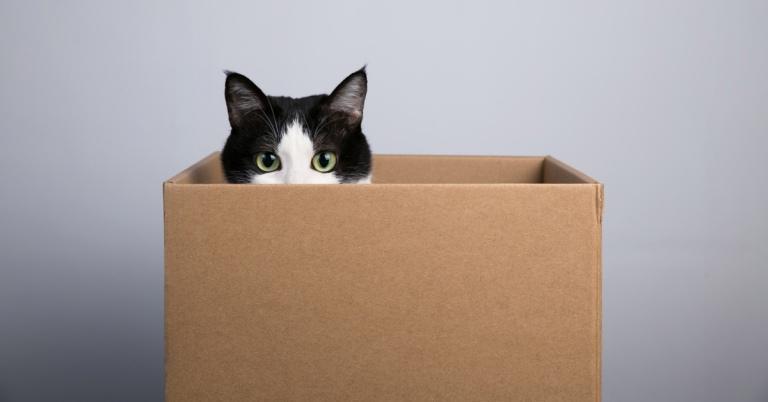
Cats love to jump in them, sit in them, chew corners from time to time, and claim all these spaces as their own personal hangout area. (Be careful, if you tend to leave clothes in the hamper for a few days instead of folding them right away, they may end up covered in cat hair and will have to be washed again!)
Thanks to a lot of funny videos From cats sitting inside a square taped to the ground to jumping into a giant Amazon box, there can be no doubt that cats love boxes.
So perhaps a more interesting question: Why Do cats love them that much? Let's demystify this common cat behavior.
Why do cats love boxes?
In addition to the wealth of evidence online about cats and boxes, there have also been several formal studies examining this intriguing animal behavior.
A few years ago, researchers from Utrecht University decided to investigate the possible psychology behind cats' love of boxes.
Working with a Dutch animal shelter, they conducted an experiment with some of the shelter's new cats that had just been brought into the animal shelter. In the study, 10 cats were given a cardboard box to help them get used to the new space, while nine other cats in the control group were not given a box.
The hypothesis was that if sitting in boxes makes cats feel safe, then the group given the boxes should acclimate to their new environment more easily than the control group.
Over the course of 14 days, cats in both groups were assessed using the Kessler and Turner Stress Scale to determine each cat's stress level and emotional state.
Research results
The results were statistically significant. By the end of 14 days, all 19 cats had settled in and felt more comfortable, but the box group adjusted faster than the control group.
The group that received the boxes adapted very well to shelter life just three days into the study, while the control group showed high levels of variance, with many cats taking longer to adjust. While some cats naturally adapted faster than others, there is no doubt that the boxes helped speed up the process. A cat who is likely to adjust well will do so more quickly with a simple box, and a cat who may have difficulty adjusting may benefit greatly from this source of comfort.
The study concluded that creating these safe zones helped reduce stress levels and make it easier to adjust to a new environment. These small spaces provide excellent shelter, and many animals (including humans) naturally feel comfortable in confined spaces. Overall, the researchers found what they expected to find, and their theories were confirmed.
In addition to psychological comfort, there may be physiological benefits. That these small enclosed spaces act as excellent insulators and help them regulate their body temperature. By easily retaining more body heat, cats feel comfortable and happy in their boxes.
Make your cat happy: give her a cardboard box
Overall, the study confirmed what many cat owners have already experienced and provided some psychological insight into the possible motivation behind somewhat odd behavior.
We now have concrete proof that simply giving them a small box can greatly enrich your tiny lion's life! Offering a sense of security and comfort, simple boxes can come in handy during moves or other stressful times in a cat's life.
Especially when you bring your new cat home to a new environment, your cat may immediately seek shelter. As a new cat owner, setting up their space is key.
Place a nice cardboard box or cat carrier next to the litter box to help them define their space and provide hiding places where you can predictably find them (saving you the hassle of searching the house for more difficult places they might find).
While all cats generally love boxes, it can be helpful to spend some time getting to know your cat's individual preferences for their boxes. You may or may not be able to trim the edges of the flaps or cut a shape that allows them to slide in and out easily without jumping.
Some cats will squeeze into ridiculously tiny boxes from time to time, but they may prefer something larger for everyday use.
Generally, the key is to ensure they have a size that fits around the edge. A box that is too large does not always provide the same level of comfort without physical contact with the walls of the box.
Conclusion: all cats love boxes
Interestingly enough, the affinity for cardboard boxes that we see every day in domestic cats is just as strong in big cats.
Tigers and lions are known to enjoy lounging in boxes and other enclosed spaces when given the opportunity, supporting the idea that sitting in boxes satisfies some evolutionary need for security in both big and small cats.
Cats will be cats, no matter how big they are, but perhaps the truth is that lions will be lions, no matter how tiny they are.