British vs Scottish. 8 differences
The British ears are standing, while others are tilted down, so this breed is also known as the Scottish Vislouhai. However, the fact is that straight -up kittens are necessarily born in Scottish litters, since the mating of two flowering cats is fraught with high genetic risk. Right-haired kittens are called struts, and although they are purebred Scots, it is not so easy to distinguish them from British cats.
1. Ears
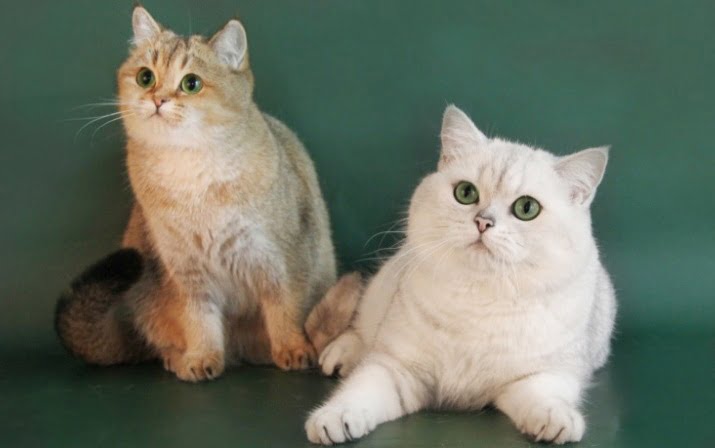
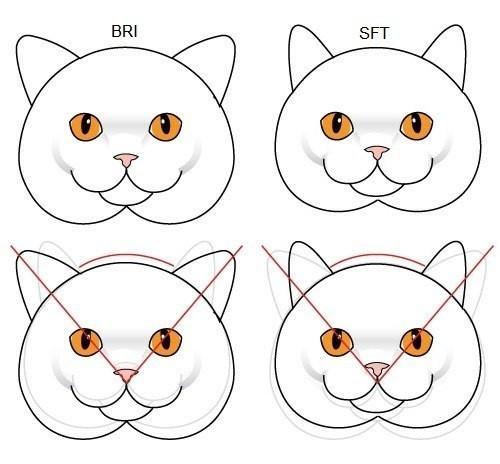
Ears are the main feature by which these cat breeds can be distinguished from each other. The British have medium, erect ears (slightly set to the sides), but the Straights, although the ears are also straight, are narrower at the base than the British, set almost vertically. Narrow straight headphones will not look harmonious on the massive, heavy head of a British cat.
2. Head
Felinologists can also distinguish these two cat breeds by the shape of their heads – the Scots have a rounder head, reminiscent of an owl’s head. The British have small heads
more oval, they have more pronounced cheekbones, while the Scots have a well-defined chin and an unusually strong jaw.
3. Size
British cats are distinguished by their strong body and massive bones. The Scots are more subtle, more elegant. True, both of them are physically well developed. However, the English are real heavyweights, and the Scots, although muscular, are much lighter and more compact. In a word - track and field athletes. A British adult weighs from 4 to 7 kg, and a Scotsman weighs from 3 to 5 kg.
4. Legs
British cats have short and thick legs, while Scottish cats have longer and thinner legs. On the other hand, the paws of both of these breeds are large and round.
5. Tail
The British have a much thicker and shorter tail with a rounded tip, while the Scots have a tail of medium thickness and very flexible (a mandatory standard requirement) with a slightly pointed tail.
6. Eyes
Both of them are round and widely spaced; only the British and Scottish representatives have this feature. Others were given the expression of a child's face by professionals. Eye color can be different, it all depends on hair color.
7. Wool
It is almost the same for both varieties, but there are a couple of differences. The British coat has a more supple feel to the touch, while the Scotch coat is much softer and may be slightly longer than the British coat. However, in general, both breeds have short, thick, fine-textured fur with a thick undercoat that feels like a stove. When it comes to coat color, both breeds allow for many variations.
8. Character
The British are typical representatives of England: very reserved, regal, independent and persistent. The British will not tolerate mumbling in their hands! The following rule can be applied to this breed: “Respect the cat, and the cat will respect you!” Phlegmatic British cats love solitude much more than Scottish ones, so they can remain alone at home for a long time without any problems.
The Briton himself will let his owner know when he needs affection and attention, and the rest of the time he will be grateful if he is not touched.
The Scots are much more affectionate and playful. It is much easier for them to cope with the fact that you want to take them on your lap and caress them, they enjoy playing and playing with children. However, it won't hurt if the child starts rubbing his hands, which can quickly result in scratches. They are much more sociable and mobile than lay Britons. Very curious, will be everywhere where the owner is, will participate in his every action. The British rarely choose a specific family member as their authority figure. The Scots almost always do this. True, these character traits cannot be applied to everyone; there are exceptions.
If we talk about the habits of these cats, then British cats, unlike Scottish ones, are not inclined or do not know how to sit on a post on their hind legs.