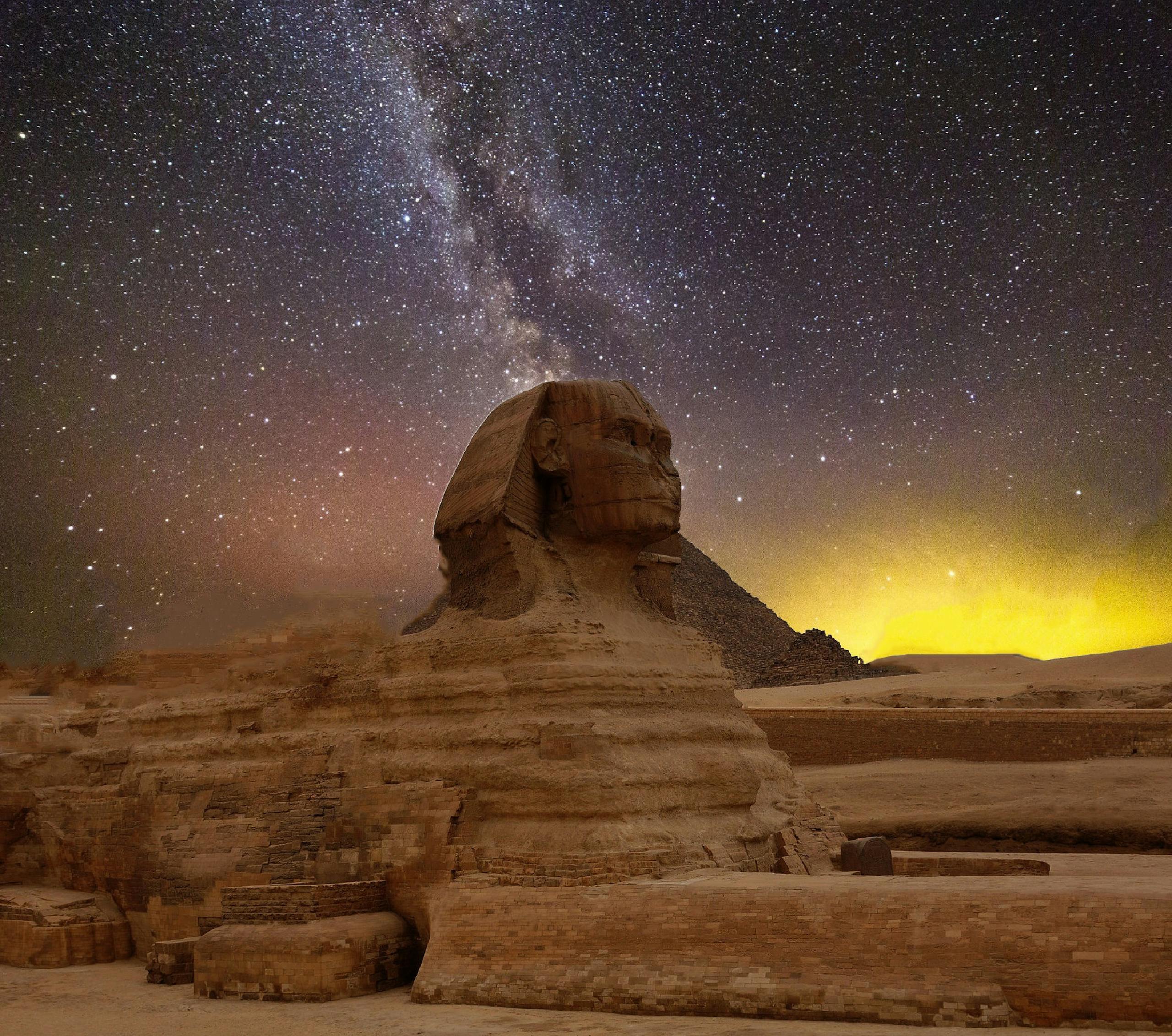
5 myths about the Sphinxes that it's time to debunk
Introduction
Myths about the Sphinxes: 5 delusions that it's time to debunk
Content
Sphinxes, mysterious creatures with the body of a lion and the head of a person, for centuries have fascinated the imagination of people. Shrouded in secret and legends, they became the subject of numerous myths and misconceptions. In this introduction, we debunge five common myths about the Sphinxes, from their alleged prophetic abilities to their true purpose in the ancient world. Join us to separate the facts from fiction and reveal the truth about these cult monuments.
Ancient aliens
The Sphinxes, these majestic guards carved from stone, fascinated humanity for centuries. Their mysterious smiles and the silent presence gave rise to countless theories and legends, many of which, unfortunately, are far from the truth. Let's go on a trip to debunk some of the most common myths surrounding these ancient giants.
Firstly, you can often hear that the sphinxes were built by aliens. This idea, although exciting, has no scientific evidence. Archaeological finds and historical notes clearly indicate that the Sphinxes, in particular the Great Sphinx in Giza, were created by the ancient Egyptians. They used their advanced engineering skills and a deep understanding of astronomy and mathematics to carve these monumental statues from whole rocky rocks. Moreover, hieroglyphs and artifacts found around the Sphinces contain detailed information about their construction and purpose, which further confirms their Egyptian origin.
Further, there is a widespread opinion that the sphinxes were built to protect secret tombs or treasures. Although the Sphinxes, of course, had symbolic significance and were often located next to the temples and pyramids, their main function was not in protection. Rather, they served as symbols of tsarist power and divine power. The Great Sphinx, for example, depicts the pharaoh Hafra, uniting human intelligence with the power of the lion, which emphasizes its role as the ruler and defender of Egypt. Thus, their presence was more connected with the demonstration of power and religious beliefs than with the protection of material values.
Another myth that needs to be dispelled is that all the sphinxes have human faces. In fact, the sphinxes come in different shapes and sizes, with the heads of various animals, such as falcons, rams and even hawks. These various forms reflected various deities and symbolic meanings associated with each animal. For example, the Sphinx with the head of a ram was often associated with God Amon, symbolizing fertility and strength. Therefore, the idea that all sphinxes have human faces is a simplification of their rich and diverse iconographic heritage.
In addition, many believe that the sphinxes have always been buried in the sand and have been discovered only recently. Although the truth is that the Great Sphinx was periodically entered with sand throughout its history, it was never completely forgotten. Over the centuries, numerous attempts have been made and restore the statue, starting from ancient times and lasting to the present day. In fact, some parts of the Sphinx, such as his head, have always remained visible, recalling its existence and inspiring generation of researchers and travelers.
Finally, there is a myth that the nose of the Great Sphinx was destroyed by the cannon core of Napoleon. However, this story has no historical grounds. The drawings and descriptions of the Sphinx, made long before the Napoleonic campaign in Egypt, show that the nose was already absent. The most likely cause of damage is erosion caused by wind and sand, as well as deliberate destruction, possibly religious fanatics in the Middle Ages. Thus, attributing to Nar’s destruction Napoleon is simply a popular, but inaccurate legend.
In conclusion, the sphinxes continue to captivate us with their ancient history and mysterious presence. Delassing these common myths, we can better evaluate their true meaning as symbols of tsarist power, divine power and engineering skill of the ancient Egyptians. Let these stone guards continue to inspire us to study and discover the miracles of the past, but with a share of skepticism and the desire for truth.
Lost technologies
Many believe that the sphinxes were built using advanced, "lost" technology unavailable to modern man. This idea is often supported by suggestions that huge stone blocks were moved and installed with incredible precision, which is impossible without the use of some secret knowledge. However, archaeological research and experiments have shown that the ancient Egyptians, using simple but effective tools such as levers, ramps and sleds, were quite capable of moving and installing these massive blocks. Of course, this required a lot of work and organization, but not some mystical technology.
Another common myth is due to the fact that under the Great Sphinx, secret chambers and tunnels containing ancient knowledge or even portals in other dimensions are hidden. Although studies have really identified some cavities and passages around the Sphinx, there is no evidence of any significant underground complexes or treasures. These cavities are most likely the result of natural erosion and construction work carried out at different periods of history.
In addition, they often argue that the face of the great Sphinx was deliberately disfigured to hide his true identity. Some believe that initially it was the face of another pharaoh or even the deity, which was later changed. However, it is more likely that the damage to the face of the Sphinx, especially the lack of nose, is the result of natural erosion and vandalism for centuries.
Finally, there is an opinion that the sphinxes possess some mystical forces or abilities, for example, to protect from evil or to bestow wisdom. Although the Sphinxes, of course, are symbols of power, power and mystery, there is no evidence that they have any supernatural abilities. Their true power lies in their ability to inspire us, make us think about the past and admire the achievements of ancient civilizations.
Sphinxes are not just stone sculptures, but evidence of human ingenuity and desire for greatness. Delassing the myths surrounding them, we can better assess their true historical and cultural value. Instead of looking for signs of lost technologies or mystical forces in them, let's admire their beauty, scale and what they tell us about the past.
The curse of the pharaohs
The Sphinxes, these majestic creatures with the body of a lion and the head of a person, have fascinated the imagination of people for centuries. Shrouded in myth and myths, they are often portrayed as guardians of ancient secrets and harbingers of fate. However, like many other aspects of ancient history, a lot of delusions have developed around the sphinxes. Let's analyze some of the most common myths and separate the facts from fiction.
Firstly, it is worth mentioning the notorious “curse of the pharaohs,” which is believed to fall on those who disturb the peace of ancient tombs. Although sphinxes are often associated with guarding these tombs, there is no historical evidence to suggest that they were responsible for any curse. Rather, it is a romanticized idea popularized in literature and cinema, especially after the discovery of Tutankhamun's tomb. In fact, sphinxes probably served as symbols of royalty and power rather than instruments of revenge.
Further, there is a common opinion that all the sphinxes were created by the ancient Egyptians. Although the Great Sphinx in Giza is certainly the most famous, the sphinxes are found in various cultures, including Greek and Asian. Greek sphinxes, for example, were often depicted with wings and female head, and they, as a rule, were more sinister than their Egyptian analogues. Thus, it is important to remember that the Sphinx concept is not exclusively Egyptian.
In addition, many believe that the Great Sphinx has always been buried in the sand until it was excavated in modern times. However, although the Sphinx was really periodically entered by sand for centuries, it has never been completely hidden. Throughout history, various attempts were made to clear it, and even during the periods when he was partially buried, his head always remained visible.
Another myth concerns the goal of the Sphinx. It is often assumed that it was built to protect the Giza pyramids. However, although the Sphinx is located next to the pyramids, there is no direct evidence confirming this theory. In fact, its exact purpose remains the subject of disputes among Egyptologists. Some believe that he served as a symbol of the pharaoh Hafra, whose complex of the pyramids is nearby, while others believe that he had more religious or astronomical significance.
Finally, there is a misconception that the Sphinx was originally painted. Although this may seem incredible, there is evidence that the Sphinx was really covered with paint. Traces of red and yellow paint were found on its surface, which suggests that it was once much brighter than we see it today. Unfortunately, most of this paint disappeared over time due to erosion and other factors.
In conclusion, the sphinxes are undoubtedly exciting and mysterious creatures. However, it is important to approach their history with critical thinking and separate the facts from fiction. Delassing these common myths, we can get a more accurate idea of these ancient monuments and their true meaning.