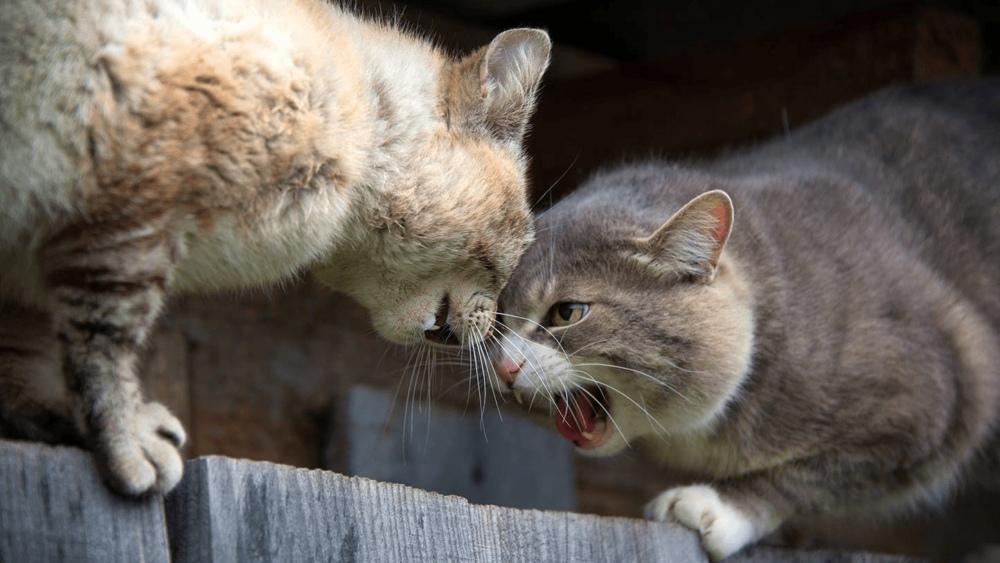
The cats are fighting. What you need to know about cat fights.
Usually the reason for a quarrel is the defense of territory - for cats, the conquered territory is closely connected with the extraction of food, and for cats - with the need to provide living space for babies.
Content
This does not mean that any attempt to stick a paw into the territory of another cat ends in a fight - there are also neutral areas of the earth where you can make contact without unnecessary emotions. Cats, whose territories are always about ten times larger than those of cats (regardless of the density of cats in a given territory), browse many partially overlapping territories and roam the domains of multiple cats. But if they happen to encounter a stranger, cats may threaten each other or simply avoid conflict and wait their turn to visit one or another part of the territory. Duels most often occur between competing cats.
Progress of the battle
A dominant cat sees an opponent and approaches him on long, outstretched legs - this makes him look more powerful. An even more threatening impression is made by tangled hair along the entire length of the back. Because the animal's fur is longer towards the tail, the line of its back curves upward in that direction. The attacking cat takes on an appearance that is completely opposite to the silhouette of the weaker opponent lying on its back. Pointing the back of his head, hissing and growling, the attacker slowly moves forward, observing the possible reaction of the terrified enemy.
Neutering significantly reduces a cat's motivation to defend its territory.
Approaching the opponent closely, the attacking cat makes a special movement - it slowly raises its head up and tilts it to the side, while persistently looking at the enemy. The attacker then steps forward and tilts his head to the other side - these movements can be repeated several times, but chopping the head in a bite position says: this is what you get!
The closer the cats get to each other, the slower their movements become, until both become frozen in a protracted stalemate that can last many minutes. The cats howl all the time, but neither side is ready to capitulate. Cats can move away from each other very slowly, because increasing the apparent distance is tantamount to admitting weakness, which can encourage the opponent to attack, so both fighters - to maintain their social position - must retreat with subtle movements.
Even the most ruthless are afraid
When a threat escalates into a serious fight, the attacker's main goal is to deliver a fatal bite to the neck of his opponent, using much the same techniques as when killing prey. When this happens, the prey immediately turns around and defends itself with its teeth, kicking with its front and hind legs - the fluttering of feathers and roars turn into howls and piercing growls. The fight does not last long, the opponents soon move aside and resume their threat.
True, since the opponent is usually the same size, a fatal bite is almost never made - even the most cowardly cat will defend itself and even the most cruel bully will be so afraid of being wounded that he will lose the ability to hunt and, therefore, survive. But the attack can be repeated several times until one of the cats gives up and remains lying on the ground with its ears flattened. At this point, the winner turns at right angles to the loser and begins to pat the ground with great concentration - this is a ritual action, a demonstration of victory that signals that the opponent's surrender has been accepted and the fight is over.
Interesting:
- A cat can also start a fight with a cat, because in a wild pack animals of both sexes can dominate.
- Shorthaired cats are usually the most warlike, especially Burmese and Oriental cats.
- In the wild, cat fights are rare because there is no shortage of space. In crowded cities, cat territories are very compressed and often overlap, so city dwellers can be considered big hooligans.
How big is a cat's territory?
- Domestic cats that become feral and live in remote areas with unlimited space can occupy areas of more than 40 hectares.
- Typical country house cats occupy almost the same area; Country cats, however, are more frugal - they usually only use about 6 hectares.
- In cities and suburbs, cat territories are significantly reduced. We can assume that a cat’s standard territory is a radius of about a kilometer around the house, but if the cat is well-fed, then it may not need a particularly wide territory.